Next Level Performance
September 28, 2026 • 11 min read
Our Verdict
For most 2015-2021 Mk7 GTI builds, the Garrett PowerMax Stage 1 turbo is the smarter buy: it flows enough for 400-485 hp while keeping street-friendly spool. Step up to the Stage 2 only if you are running E85 and built internals toward the 500-600 hp range.
Winter downtime is the perfect window to tear into a big-turbo swap on the EA888 2.0T — a multi-day job you do not want to rush — so the car is dialed and leak-free by spring. Both PowerMax kits are direct-fit, twin-scroll units with calibrated electronic actuators.
Shop Our Top Pick →A Mk7 GTI turbo upgrade is the single biggest power move you can make on Volkswagen's EA888 Gen3 2.0T, and the off-season is exactly when it should happen. The factory IHI IS20 turbo on the 2015-2021 Golf GTI makes roughly 210-228 crank horsepower and taps out around 300 wheel horsepower even on an aggressive tune. Replacing it with a Garrett PowerMax bolt-on turbocharger unlocks a completely different power band — up to a claimed 485 hp on the Stage 1 kit and 600 hp on the Stage 2. This guide compares the two Garrett PowerMax stages head-to-head, breaks down the supporting hardware you will need, and explains what to realistically expect on a Mk7 GTI when the snow finally melts.
Why Do a Mk7 GTI Turbo Upgrade in Winter?
Winter is the ideal time for a Mk7 GTI turbo upgrade because a turbo swap is a multi-day teardown, not a Saturday bolt-on. Pulling the IS20, routing new charge pipes, fitting a front-mount intercooler, flashing a custom tune, and completing a proper heat-cycle break-in is exactly the kind of project that benefits from the car being off the road anyway. Most GTI owners in colder states are already on winter tires and not chasing back roads, so the December-through-February stretch is free build time.
The starting point matters. The 2015-2017 Mk7 GTI is rated at 210 hp and 258 lb-ft; the 2018-2021 Mk7.5 climbs to 220-228 hp with the performance package. That power comes from the compact IS20 turbo, which spools hard and hits full boost by roughly 3,200 rpm — the source of the GTI's famous mid-range punch. The trade-off is a low ceiling: even a Stage 1 ECU flash on the stock IS20 lands around 268 wheel horsepower on 93 octane, and Stage 2 with a downpipe and high-flow exhaust pushes to about 315 wheel horsepower before the little turbo runs out of breath. To go further, the turbo itself has to grow.
In our Tampa shop we treat a Garrett PowerMax swap as the capstone of a Mk7 build — the mod you do after the intercooler, charge pipes, and exhaust are already sorted. If you have already worked through intercooler and cooling upgrades and a cat-back exhaust, the turbo is what turns a quick daily into a genuine 400-plus-horsepower hatch.
Garrett PowerMax Stage 1 vs Stage 2: Quick Comparison
The core decision is turbo size. The Garrett PowerMax Stage 1 (part 898199-5001W) uses a GT2260S-based frame with a 47mm/60mm compressor wheel and is rated to 485 hp at the flywheel. The Stage 2 (part 898200-5001W) steps up to a larger G25-660 frame with a 54mm/67mm compressor — roughly 59% more flow than the OEM IS38 — and is rated to 600 hp. Both are direct-fit replacements for the factory IS20 (and the IS38 on Golf R/S3 applications), share a Mar-M alloy turbine wheel and a stainless twin-scroll housing rated to 1050°C, and ship with a calibrated electronic wastegate actuator for OEM-style control.
| Kit | Base Frame & Compressor | Peak Power (flywheel) | Best For | Price |
|---|---|---|---|---|
| Garrett PowerMax Stage 1Top Pick | GT2260S, 47/60mm | 485 hp | 362 kW | Street/track builds, 400-485 hp | $1,620.24 |
| Garrett PowerMax Stage 2 | G25-660, 54/67mm | 600 hp | 447 kW | Max-effort E85 / built motor | $3,370.70 |
Key Specifications — PowerMax Stage 1 (Top Pick)
Garrett PowerMax Stage 1 (485 HP): The Street Sweet Spot
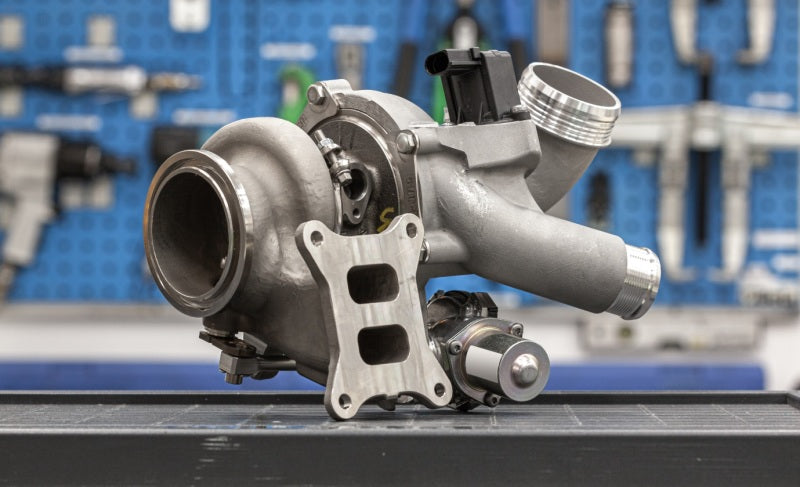
The Garrett PowerMax Stage 1 is the right turbo for the vast majority of Mk7 GTI owners. Built on a GT2260S frame with a 47mm inducer / 60mm exducer compressor, it is only modestly larger than the factory unit, so spool stays close to stock and the car remains a genuine daily driver. Garrett rates it to support 485 hp (362 kW) at the flywheel with a maximum turbo speed of 185,000 rpm — more than double what a stock IS20 GTI puts down. On a properly tuned Mk7 GTI with a front-mount intercooler and fueling to match, that translates to real-world numbers in the 380-450 wheel-horsepower window on pump gas and E85 blends.
What We Like
- + Near-stock spool — still a livable daily driver
- + 485 hp ceiling covers almost any street/track goal
- + Direct-fit with a calibrated electronic actuator
Things to Consider
- – Requires a custom tune plus supporting hardware
- – Non-CARB / off-road only; cannot ship to California
Garrett PowerMax Stage 2 (600 HP): Maximum Effort
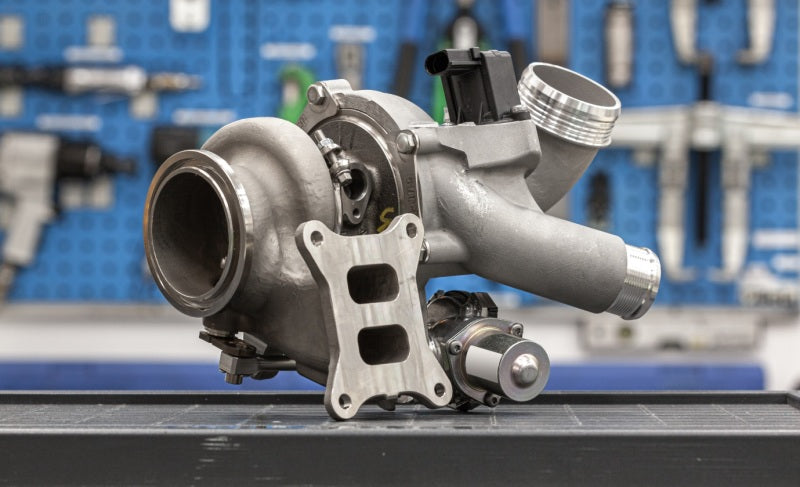
The Garrett PowerMax Stage 2 is the turbo for GTI owners chasing 500-600 horsepower who have already committed to a built engine and E85. Its G25-660 frame carries a 54mm/67mm compressor that flows about 59% more air than the OEM IS38, and Garrett rates it to 600 hp (447 kW) with a 165,000 rpm speed limit. The bigger wheels mean noticeably later spool than Stage 1, so this kit rewards a high-rpm, roll-racing style of driving over stoplight punch. It is overkill for a street car on stock internals — but for a purpose-built Mk7, it is the difference between a fast hatch and one that embarrasses six-cylinder sports cars.

The Stage 2 G25-660 frame flows about 59% more than a stock IS38.
What We Like
- + 600 hp ceiling — the most flow on the EA888 platform
- + G25-660 core is race-proven and rebuildable
- + Same direct-fit, OEM-style actuator install as Stage 1
Things to Consider
- – Later spool — needs revs and E85 to shine
- – 600 hp requires forged rods/pistons and upgraded fueling
Supporting Hardware Your Turbo Upgrade Needs
A Garrett PowerMax turbo is only as good as the hardware feeding it. On the Mk7 GTI, three supporting mods are effectively mandatory before you turn up the boost: a larger front-mount intercooler to control charge temperatures, upgraded aluminum charge pipes to replace the failure-prone OEM plastic, and a high-flow exhaust so the bigger turbo can breathe. Skipping any of them leaves power (and reliability) on the table.
Mishimoto Performance Intercooler
The stock GTI intercooler sits sandwiched between the radiator and A/C condenser and heat-soaks quickly under sustained boost. The Mishimoto Performance Intercooler is a direct-fit front-mount that dramatically increases core volume for consistent, cooler charge air — the foundation for repeatable turbo power. It carries Mishimoto's lifetime warranty.


A larger front-mount core keeps charge temps stable under sustained boost.
aFe BladeRunner Charge Pipe Kit
The factory Mk7 charge pipes are plastic and are a well-known failure point once boost climbs. The aFe BladeRunner Hot and Cold Charge Pipe Kit replaces them with mandrel-bent aluminum tubing, stainless T-bolt clamps, and 5-ply silicone couplers, smoothing flow between the turbo and intercooler to cut turbulence and pressure loss. It is inexpensive insurance for any turbo upgrade — and this one currently carries an extra 10% off.


Aluminum charge pipes replace the OEM plastic that splits under high boost.
COBB Titanium Cat-Back Exhaust
A high-flow exhaust lets the bigger Garrett turbo breathe on the way out. The COBB Titanium Cat-Back for the Mk7 GTI is a lightweight, full-titanium system that reduces backpressure and drops weight versus the OEM steel exhaust. It is the finishing touch on an off-season turbo build — and pairs naturally with the other systems in our Mk7 GTI cat-back exhaust guide.


Full titanium construction cuts weight and backpressure over the OEM exhaust.
Spool, Power & Fitment: What to Expect
Expect a Garrett PowerMax turbo to trade a little low-end response for a massive top-end gain. The stock IS20 is fully spooled by about 3,200 rpm; the Stage 1 pushes that peak-boost point higher but stays streetable, while the Stage 2's larger G25-660 wheels move it higher still. Realistically, a Stage 1 GTI on E85 with the intercooler, charge pipes, and a custom tune lands in the 400-450 wheel-horsepower range, while Stage 2 setups on built motors chase 500-plus. Fueling is the gatekeeper: to approach the turbos' ceilings you need E85 or a port-injection/high-pressure-fuel-pump upgrade, not just software.
Reliability comes down to the bottom end. The EA888 Gen3's factory connecting rods are generally considered safe to roughly 400-450 hp; beyond that, forged rods and pistons are strongly recommended, which is why the 600 hp Stage 2 is a built-motor proposition rather than a bolt-on. Both PowerMax turbos are direct-fit for the 2015-2021 GTI (and Golf R/Audi S3/A3 applications) and ship with a calibrated electronic actuator, so they retain OEM-style boost control. Note that these are non-CARB, off-road-use turbochargers and cannot be shipped to California.
Frequently Asked Questions
How much horsepower does a Garrett PowerMax turbo add to a Mk7 GTI?
The Garrett PowerMax Stage 1 is rated to support up to 485 hp at the flywheel and the Stage 2 to 600 hp, versus roughly 210-228 hp stock. In the real world, a Stage 1 Mk7 GTI on E85 with supporting mods and a tune makes about 400-450 wheel horsepower, while Stage 2 built-motor cars push past 500. Both are large jumps over the stock IS20's roughly 300 wheel-horsepower ceiling.
Should I buy the PowerMax Stage 1 or Stage 2 for my GTI?
Choose Stage 1 for almost every street or track GTI. Its 485 hp ceiling and near-stock spool make it the practical pick for a fast daily on stock or lightly-built internals. Choose Stage 2 only if you are building a dedicated E85 car with forged rods and pistons targeting 500-600 hp, and you accept later spool in exchange for the extra top-end flow.
Do I need a tune and supporting mods for a turbo upgrade?
Yes — a custom tune is mandatory, and a front-mount intercooler, aluminum charge pipes, and a high-flow exhaust are effectively required. The PowerMax turbo moves far more air than the OEM IS20, so the ECU must be recalibrated for the new hardware, and the supporting parts keep charge temps, boost pressure, and exhaust flow in a safe, repeatable window.
Will the Garrett PowerMax fit a Golf R or Audi S3?
Yes. The PowerMax kits are direct-fit replacements for both the IS20 (Mk7 GTI, Audi A3) and the IS38 (Golf R, Audi S3) on the EA888 Gen3 2.0T. The turbo itself is the same; the OEM unit it replaces differs by model. Always confirm your exact year and trim against the fitment listing before ordering.
How much power can the stock GTI engine handle?
The EA888 Gen3's factory connecting rods are widely considered safe to around 400-450 hp. That headroom pairs perfectly with the Stage 1 turbo on a stock or lightly-modified engine. To safely reach the Stage 2's 600 hp rating you should upgrade to forged rods and pistons along with the fueling system.
Why do a turbo swap over the winter?
A turbo swap on the Mk7 GTI is a multi-day teardown that involves removing the OEM turbo, fitting new charge pipes and an intercooler, dyno-tuning, and heat-cycling the setup. Doing it during the off-season, when the car is already on winter tires and off the back roads, means no lost driving time and a fully sorted, leak-free build ready for spring.
Build Your Mk7 GTI This Off-Season
Shop Garrett PowerMax turbos and every supporting part for your EA888 build at NLP Performance.
Shop the Turbocharger CollectionFree shipping on select brands • Located in Tampa, FL